
← Blog · Mowing · 4 min read
How Often Should You Mow Your Lawn in Central Indiana?
2026-04-15 · by Tom · The Lawn Guy
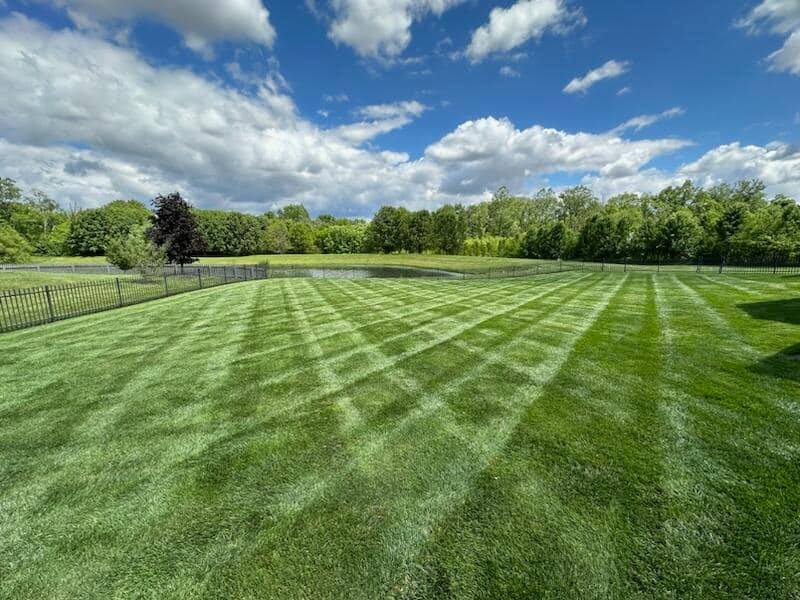
The right mowing frequency isn’t a fixed number. It changes with the season, the weather, and how your grass is growing. But there’s one universal principle that covers all of it.
The 1/3 Rule
Never cut off more than 1/3 of the grass blade in a single mow.
If your grass is 4.5 inches tall, don’t cut below 3 inches. If it’s 3 inches tall, don’t cut below 2 inches. Violating this rule is the single most common cause of thin, stressed, weed-prone lawns.
Why it matters:
- Cutting more than 1/3 shocks the plant, which diverts energy into survival mode instead of root growth
- The root system matches the blade height — taller blades mean deeper roots
- Deeper roots mean more drought tolerance, fewer weeds, stronger grass
The 1/3 rule is what the turfgrass science departments at every major agricultural university agree on. It’s not marketing. It’s how grass works.
The right cutting height for Central Indiana grass
Indiana lawns are almost entirely cool-season grass (Kentucky bluegrass, tall fescue, fine fescue, perennial ryegrass). The ideal cutting heights:
- Spring and fall (active growth): 3 inches
- Summer (heat stress): 3.5–4 inches
- Late fall final mow: 2.5 inches
Don’t scalp your lawn in summer. Taller grass shades the soil, retains moisture, and crowds out weeds. A lawn cut at 3.5 inches in July handles drought far better than one cut at 2 inches.
How often does that actually mean you mow?
Work it backward from the 1/3 rule and the ideal height:
Spring (peak growth): Weekly, sometimes every 5–6 days during the rapid growth period in May. Cool-season grass is at its most active — it can put on 1.5+ inches per week.
Early summer: Every 7–10 days. Growth slows as temps rise.
Peak summer (heat + drought): Every 10–14 days, sometimes longer. Don’t mow a stressed or dormant lawn — you’ll kill it.
Fall (second growth surge): Weekly again, especially in September and early October when grass is catching its second wind.
Late fall / winter: One or two final mows, then done until spring.
Why “Saturday every week” isn’t always right
Most homeowners mow on a fixed schedule — every Saturday morning, for example. That works in spring. It’s wrong in summer.
The signal to mow is how much the grass has grown, not how many days have passed. If it’s been 8 days and your grass is barely any taller (common in July), skip the mow. If it’s been 4 days and heavy rain plus warm temps pushed it up 2 inches, mow — don’t wait.
This is also why a good mowing service adjusts the schedule instead of blindly showing up every week and cutting whatever length it happens to be.
Mowing wet grass — when to skip it
Mowing wet grass:
- Tears rather than cuts (even with a sharp blade)
- Leaves clumps that smother the grass underneath
- Compacts soil under mower tires
- Dulls the blade faster
- Leaves ruts in soft soil
If the grass is wet enough to leave a footprint impression that stays, wait. This is one area where pros sometimes frustrate customers by rescheduling — but it’s the right call.
Sharp blade matters more than you think
Dull blades tear grass rather than cut it. Torn grass tips turn brown within a day, heal slower, and let more disease in. A sharpened blade makes a visible difference.
For a typical residential mower:
- Sharpen blade at least twice per season (spring and midsummer)
- Hit a stick or root? Sharpen immediately — even small nicks tear grass
- Professional services usually sharpen weekly
Bagging vs mulching vs side-discharging
Mulching (chopping clippings fine and leaving them on the lawn) is best for most Indiana lawns most of the time. Clippings return nitrogen and organic matter — they’re free fertilizer.
Bagging is right when:
- The grass is too long (first spring mow after winter)
- You skipped a week and clumps would suffocate the grass
- Leaves are heavy in fall
- Disease is present (mulching spreads spores)
Side-discharge works in most other cases — you’re not collecting, but the clippings are spread more evenly than mulching alone.
The “I didn’t mow and now it’s a jungle” fix
Missed a week and the grass is 6 inches tall? Don’t try to restore it to 3 inches in one mow — that’s a 50% cut, way past the 1/3 rule.
Correct move:
- Mow once at 4 inches (removes 1/3 or so)
- Wait 2–3 days for the grass to recover
- Mow again at 3 inches
Yes, it’s two mows. Yes, it’s worth it. One aggressive cut can brown out the lawn for two weeks.
The bottom line
- Keep the blade at 3 inches (3.5 in summer)
- Cut no more than 1/3 of the blade per mow
- Mow by growth, not by calendar
- Sharpen the blade twice a season minimum
- Mulch the clippings unless there’s a reason not to
A Central Indiana lawn mowed on this schedule will be thicker, greener, and have fewer weeds than one that’s mowed short every 7 days regardless of conditions.
Don’t want to think about it? The Lawn Guy runs scheduled weekly (or as-needed) mowing across New Palestine, Fortville, Greenfield, and Hancock County with sharp blades and the right cutting heights for the season. Call Tom at (317) 517-0728 to get on the schedule.
Need help with your yard?
Tom handles mulching, mowing, planting, cleanup, and aeration across New Palestine, Fortville, Greenfield, and Hancock County. Call for an honest quote.
Call (317) 517-0728 Send a Message